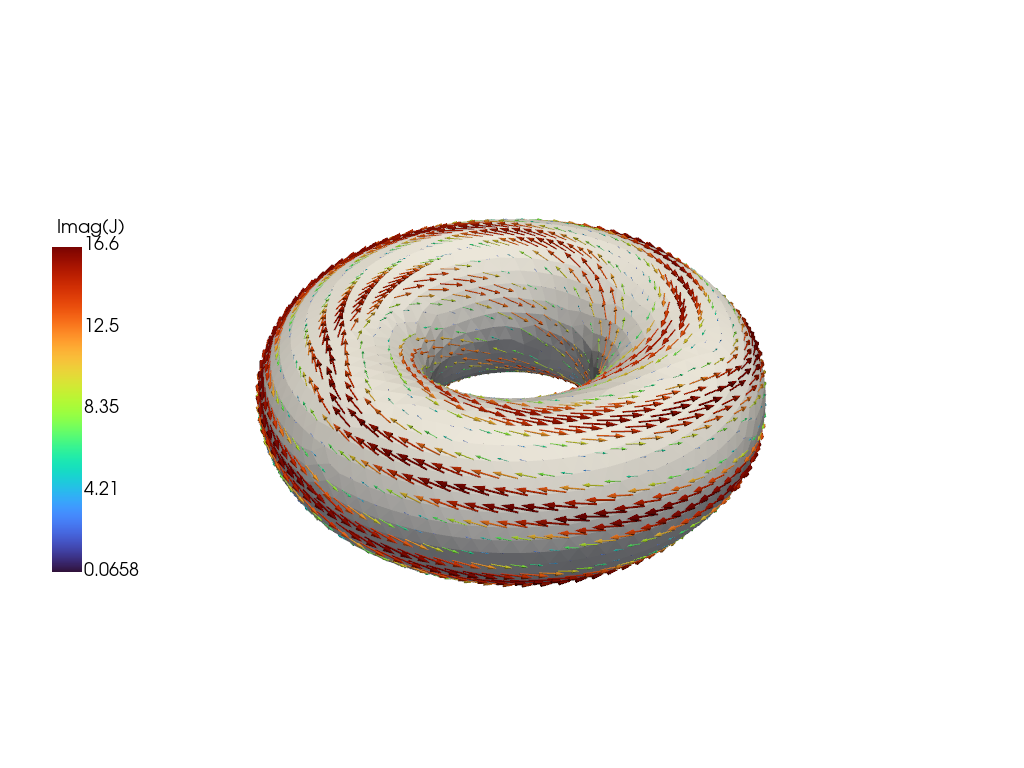
In this example we demonstrate how to compute frequency response for a model from both coils and the plasma mode computed in ThinCurr Python Example: Compute current potential from B-norm.
- Note
- Running this example requires the h5py and pyvista python packages, which are installable using
pipor other standard methods.
Load ThinCurr library
To load the ThinCurr python module we need to tell python where to the module is located. This can be done either through the PYTHONPATH environment variable or within a script using sys.path.append() as below, where we look for the environement variable OFT_ROOTPATH to provide the path to where the OpenFUSIONToolkit is installed (/Applications/OFT for binaries on macOS).
Compute frequency response
Setup ThinCurr model
We now create a ThinCurr instance to use for equilibrium calculations. As this is a larger model, we use nthreads=4 to increase the number of cores used for the calculation. Once created, we setup the model from an existing HDF5 and XML mesh definition using setup_model(). We also initialize I/O for this model using setup_io() to enable output of plotting files for 3D visualization in VisIt, Paraview, or using pyvista below.
#----------------------------------------------
Open FUSION Toolkit Initialized
Development branch:   main
Revision id:          8440e61
Parallelization Info:
  Not compiled with MPI
  # of OpenMP threads =    4
Fortran input file    = oftpyin
XML input file        = none
Integer Precisions    =    4   8
Float Precisions      =    4   8  16
Complex Precisions    =    4   8
LA backend            = native
#----------------------------------------------


Creating thin-wall model
 Orientation depth =        3122
  Loading V(t) driver coils
  Loading I(t) driver coils

  # of points    =         2394
  # of edges     =         7182
  # of cells     =         4788
  # of holes     =            2
  # of Vcoils    =            0
  # of closures  =            1
  # of Icoils    =            1

  Building holes

  Loading region resistivity:
     1  1.2570E-05
Create sensor file
Before running the main calculations we will also define some sensors to measure the magnetic field. In ThinCurr all sensors measure the flux passing through a 3D path of points, but there are several helper classes to define common sensors (eg. Poloidal flux and Mirnovs). Here we define two Mirnov sensors to measure the Z-component of the magnetic field 5 cm on either side of the torus. save_sensors() is then used to save the resulting sensor for later use.
Compute self-inductance and resistivity matrices
With the model setup, we can now compute the self-inductance and resistivity matrices. A numpy version of the self-inductance matrix will be stored at tw_plate.Lmat. By default the resistivity matrix is not moved to python as it is sparse and converting to dense representation would require an increase in memory. These matrices correspond to the \(\textrm{L}\) and \(\textrm{R}\) matrices for the physical system
\(\textrm{L} \frac{\partial I}{\partial t} + \textrm{R} I = V\)
- Note
- For larger models calculating the self-inductance may take some time due to the \(N^2\) interaction of the elements (see ThinCurr Example: Using HODLR approximation for more information).
 Building element<->element self inductance matrix
     Time =  5s
 Building resistivity matrix
Compute frequency response from coils
For the first case we will compute the frequency response on the model to current driven in the coil set specified in oft_in.xml at 1 kHz. To do this we first compute the coil to model mutual inductance matrix using tw_plate.compute_Mcoil(). Then we compute a purely real driver voltage by using the first row of this matrix (equivalent to multiplying by 1). Finally we use tw_plate.compute_freq_response() to compute the frequency response to this input.
 Building coil<->element inductance matrices
     Time =  0s
 Building coil<->coil inductance matrix

 Starting Frequency-response run
   Frequency [Hz] =   1.00000E+03
 Starting GMRES solver
     0  0.000000E+00  1.133720E+01
    60  2.097016E-01  1.077125E-03  5.136466E-03
   120  2.105014E-01  1.787020E-05  8.489348E-05
   180  2.104196E-01  7.443755E-07  3.537576E-06
   240  2.104221E-01  1.549770E-09  7.365053E-09
   Time =   0.75391699999999995
Save currents to plot files
The resulting currents are saved for plotting using tw_plate.save_current(). Here we save the real (Jr) and Imaginary (Ji) components of the response for visualization. Once all fields have been saved for plotting tw_plate.build_XDMF() to generate the XDMF descriptor files for plotting with VisIt of Paraview.
Removing old Xdmf files
Creating output files
Compute sensor mutual inductance matrices
We can also compute the pickup of sensors in response to both the coil and the eddy currents. To do this we compute the mutual coupling matrices between the sensors and model and the sensors and the driver coils (icoils).
 Loading floop information:
   # of floops =           2
 Building element->sensor inductance matrix
 Building coil->sensor inductance matrix
Print probe signals for frequency response
Real:  -4.91207E-06, Imaginary:  -1.37454E-08
Real:   3.89336E-06, Imaginary:  -1.95259E-08
Setup plasma mode driver model
Creating thin-wall model
 Orientation depth =       12640
  Loading V(t) driver coils
  Loading I(t) driver coils

  # of points    =         6320
  # of edges     =        18960
  # of cells     =        12640
  # of holes     =            3
  # of Vcoils    =            0
  # of closures  =            2
  # of Icoils    =            0

  Building holes


WARNING: Unable to find "thincurr" XML node
WARNING: No "thincurr" XML node, using "eta=mu0" for all regions
Compute coupling from plasma mode to torus model
 Applying MF element<->element inductance matrix
     Time = 24s
Compute frequency-response to plasma modes
 Starting Frequency-response run
   Frequency [Hz] =   1.00000E-03
 Starting GMRES solver
     0  0.000000E+00  5.096814E-04
    60  1.688020E-04  9.784296E-07  5.796316E-03
   120  1.732213E-04  4.697510E-07  2.711855E-03
   180  1.852839E-04  3.538349E-07  1.909690E-03
   240  1.927548E-04  2.728285E-07  1.415417E-03
   300  2.043648E-04  2.103251E-07  1.029165E-03
   360  2.102327E-04  1.653286E-07  7.864074E-04
   420  2.190889E-04  1.267897E-07  5.787135E-04
   480  2.228605E-04  9.916932E-08  4.449839E-04
   540  2.293144E-04  7.454560E-08  3.250803E-04
   600  2.314995E-04  5.727873E-08  2.474249E-04
   660  2.359685E-04  4.181621E-08  1.772110E-04
   720  2.371472E-04  3.116136E-08  1.314009E-04
   780  2.400631E-04  2.169509E-08  9.037242E-05
   840  2.406268E-04  1.547133E-08  6.429593E-05
   900  2.423754E-04  1.004465E-08  4.144253E-05
   960  2.426093E-04  6.695185E-09  2.759657E-05
  1020  2.435300E-04  3.884133E-09  1.594930E-05
  1080  2.436085E-04  2.325438E-09  9.545798E-06
  1140  2.439946E-04  1.128253E-09  4.624091E-06
  1200  2.440139E-04  5.674469E-10  2.325470E-06
  1260  2.441252E-04  2.004905E-10  8.212610E-07
  1320  2.441277E-04  7.475196E-11  3.062002E-07
  1380  2.441441E-04  1.559556E-11  6.387851E-08
   Time =    4.4159490000000003
Compute sensor mutual inductance matrices
Removing old Xdmf files
Creating output files
 Loading floop information:
   # of floops =           2
 Building element->sensor inductance matrix
 Building coil->sensor inductance matrix
Print probe signals for frequency response
Real:  -2.86249E-01, Imaginary:  -8.96706E-06
Real:  -1.22518E-01, Imaginary:   6.46085E-06
Plot current fields
Load data from plot files
Create pyvista mesh for plotting
Plot current vectors on surface